

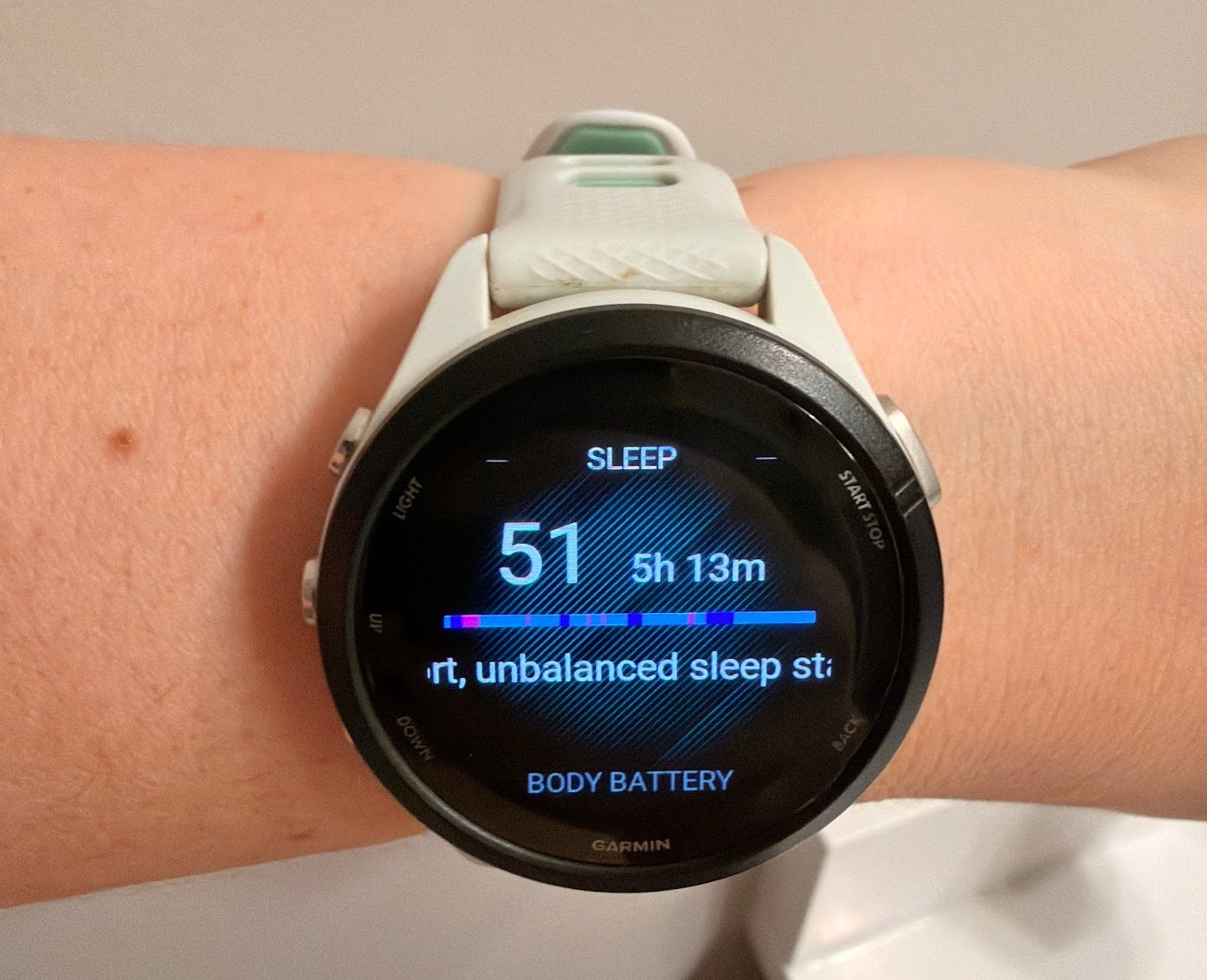
It’s 6:30 AM. Your watch is vibrating, telling you it’s time to wake up. You stop the silent alarm. You’re feeling well-rested after a good night’s sleep.
“Good morning!” your watch reads.
You swipe up to see your sleep score.
51. Huh, you feel like you slept better than that, but you guess you didn’t. You’ll be feeling tired today, so you better get a quadruple shot in your latte instead of the standard double shot.
And just like that, you’ve let a number on your smart watch dictate your day.
We’re not just letting a computer decide our next move. We’re anxious when we can’t.
There’s a name I want to give this, because I haven’t found one that quite fits: biometric outsourcing. It’s what happens when we stop asking ourselves how we feel and start asking a device instead. Cal Newport’s Digital Minimalism makes a strong case for reclaiming attention from our phones and apps (and is well worth the read), but the smart wearable is a different kind of intrusion. Your phone competes for your attention; your watch or ring competes for your self-knowledge. It tells you whether you slept well. Whether your workout was hard. Whether your stress is elevated. These are things you used to know by checking in with your body. Now you check your wrist.
Research backs this up. One study identified a placebo effect on cognitive functioning: whether you slept well or not, if you’re told you didn’t sleep well, you’ll spend the day feeling more fatigued. The opposite is true too — if you were out late drinking and only got four hours of sleep, but your watch tells you your sleep score was 90, you’ll power through the day. To be clear, I’m not arguing about accuracy. I’m arguing that even when the number is right, we shouldn’t be handing it this much power.
This isn’t just a wellness problem in the longevity-maxxing sense. It’s a burnout problem. We know burnout doesn’t announce itself with a notification. It builds quietly, and the only early warning system you have is your own ability to notice that something is off: you’re more tired than the day warrants, your patience is thinner than usual, the thing you used to enjoy now feels like an obligation. Those signals are subtle, and they require you to be listening.
When you’ve trained yourself to look at a screen for the answer to “how am I doing today,” you stop listening for the quieter signals. The watch can tell you your resting heart rate is elevated. It can’t tell you you’re three weeks away from hitting a wall. That part is still your job, and it’s a job that atrophies the less you do it.
I’d be lying if I said I was above this. I track everything.
Yesterday I was getting ready to leave for a Pilates class. I grabbed my Garmin watch from the dining room table where I had left it when I unpacked from my Italian vacation a few days prior. I moved to attach it to my wrist and… it was completely dead. I hadn’t charged it in a couple weeks because I wasn’t wearing it while on vacation.
And so began the warring thoughts:
I have 10 minutes, I can get a bit of a charge before leaving. Hopefully it’ll be enough to make it through class.
Why does it matter? My watch won’t feel the hell I’ll be going through as I take my first post-vacation Pilates class. It’s not working out, I am.
Dear reader, I am ashamed to admit that warring thought #1 won out. I charged the Garmin to 7%, wore it to class, and walked out with it down to 4%.
I’m writing this because I recognize the hold these devices have on us. I’m writing it because I haven’t figured out how to loosen it myself. My therapist (who is also a runner) has been challenging me to go for a run outside without my watch on. Just run for the sake of running.
So what can we do about it? I’m still working this out myself, but here’s where I’ve landed.
Take it off for one thing a week. Not a detox. Not a permanent break. Just one activity: a run, your watch’s activity rings, a class, a walk, a night of sleep where the data doesn’t exist. Start with whichever one feels hardest.
Check in before you check the score. When you wake up, name how you feel before you swipe. When you finish a workout, ask whether it felt good before you look at the metrics. The order matters. Once you’ve seen the number, you can’t unsee it, and your body’s report gets overwritten.
Notice the reach. Pay attention to the moment your hand goes for the watch. The reach itself is the data point. If skipping a class because the watch is dead feels like a real option, that’s worth knowing. If the thought of an untracked run makes you anxious, that’s worth knowing too. You don’t have to fix it yet. Just see it.
Separate the metric from the meaning. A run without a watch is still a run. A night of sleep without a tracker still happened. The workout was hard or it wasn’t, regardless of what your heart rate zones say. Practice letting the experience count without the receipt. (I know, this is Strava blasphemy. I’m sorry.)
I haven’t taken my watch off for a run yet. I’m still tracking. But I notice the reach now, and that’s new. Maybe that’s where it needs to start: I don’t need to get rid of my watch, but perhaps I can take a moment to ask myself if I really need to wear it right now.
Such honesty in what you share 🫶 I often wonder if the need for those devices stems from the fact we can't trust what our bodies have been quietly saying for a while. We're so used to the loud. A whisper can't be a real insight
I had an event a while back where my phone had died so I couldn't track my long run in the "proper" sense and it wound up being one of the most "zen" experiences in my life. I completely understand that tension as a data junkie.
One potential middle ground that has helped me. Bring the watch, but "mute" it (if possible) or just make sure not to check it at your mile paces and think about stride and breathing. This has been giving me some "mini zen" as I fight against the "quantified life" and oddly enough I'm actually running better than when I was focusing on those splits. 🤔